Tina
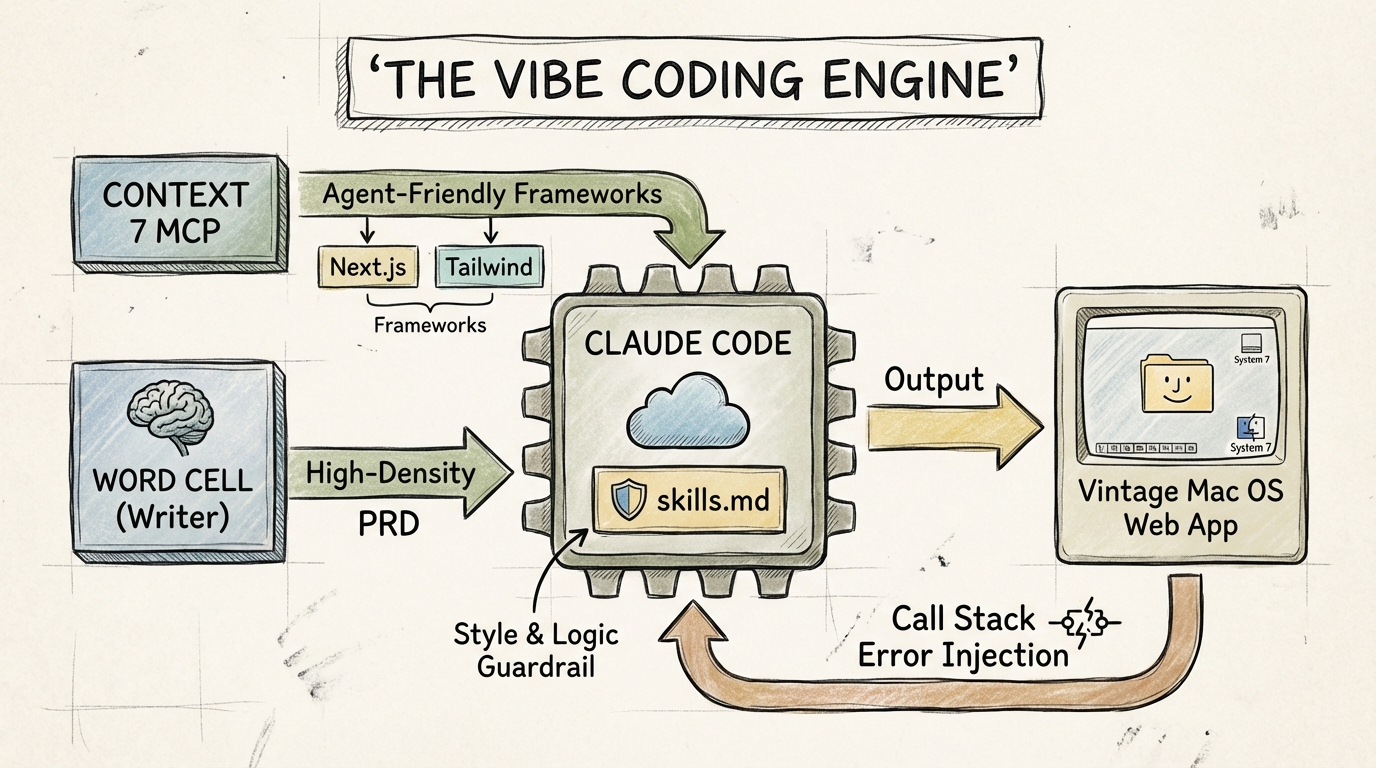
Vibe coding shifts software development from logic-heavy 'shape rotating' to descriptive 'word cell' power, where the quality of the PRD and the skills.md file dictates the success of one-shot generation.
Key Insights
The Word-Cell Renaissance in Programming
03:06:08Writers often outperform traditional coders in the agentic era because the ability to 'cast spells' through precise, descriptive specification is now more valuable than manual syntax management.
Skills.md as Persistent Project Guardrails
03:21:42Use a 'skills.md' file to store UI systems, style guides, and specific task instructions. This acts as an in-context guardrail that ensures Claude maintains consistency across multiple generation sessions without repetitive prompting.
Framework Selection via 'Token Density'
03:18:37Choose tech stacks (like Next.js and Tailwind) based on their popularity in agent tool libraries like Context 7. Agents perform better on these because 'tokens don't lie'—they have the highest training data density.
One-Shot Success via High-Density PRDs
03:22:53The bottleneck for vibe coding is no longer the model's coding ability but the human's ability to write a specific Product Requirement Document (PRD). Detailed specs are the primary lever for one-shot app generation.
Systems
Agentic Debugging Workflow
- Identify the failure in the browser console or terminal.
- Copy the entire call stack and error message.
- Paste the error directly into the Claude Code CLI.
- Allow the agent to navigate the repository and self-correct the code base.
Stack Optimization for Agents
- Consult Context 7 (MCP server) to identify the most called APIs and tools by agents.
- Cross-reference Open Router data to select models optimized for specific use cases (e.g., finance vs. creative).
- Implement 'Better Auth' for pre-built UI authentication to minimize custom logic requirements.