Ben
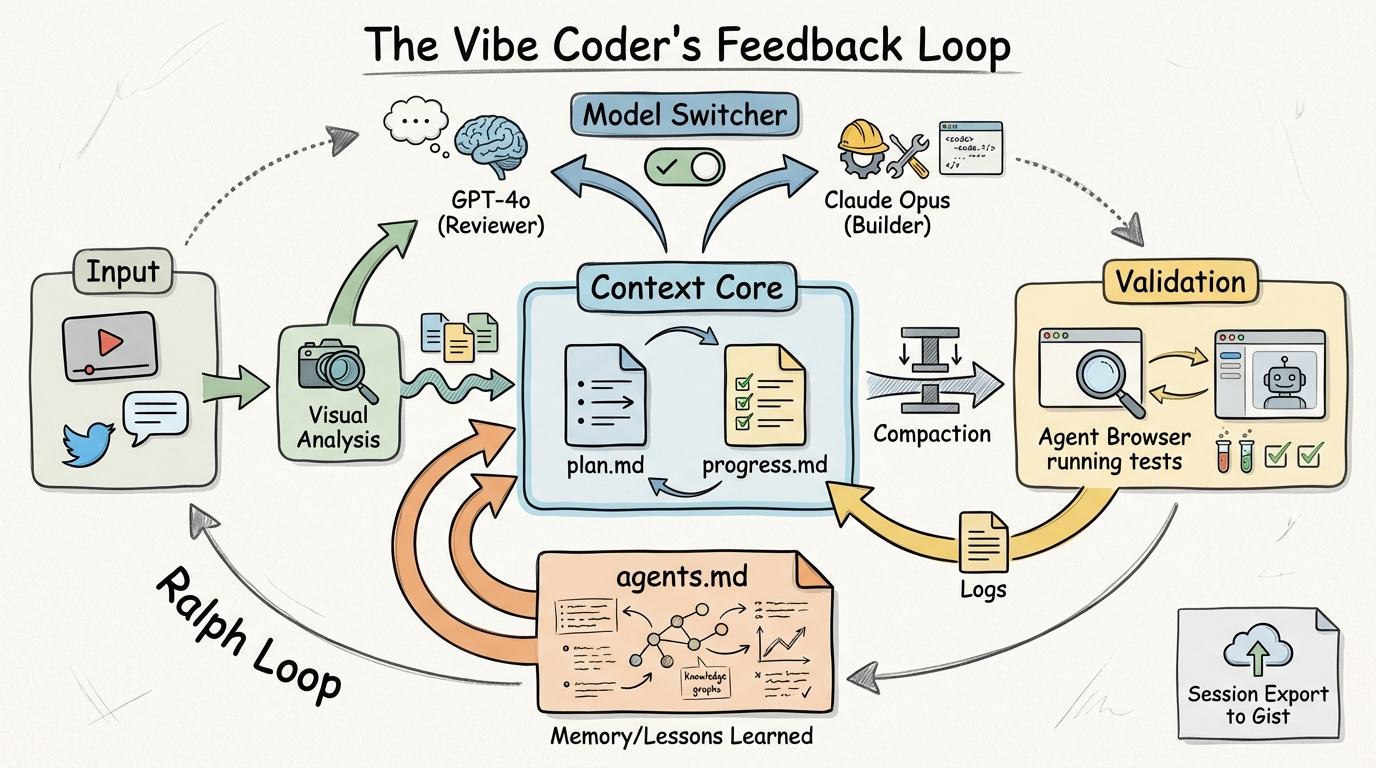
Vibe coding is the art of guiding agent context through structured state files (plan.md, progress.md) and iterative model-switching to build production-ready software without manual coding.
Key Insights
Maintain State with Plan and Progress Files
00:45:14To prevent agents from losing context in long sessions, maintain a 'plan.md' for the master strategy and a 'progress.md' to track completed tasks. This 'Ralph Loop' ensures the agent always knows the current state and next steps.
Asymmetric Model Switching for Quality Control
00:43:02Switch models mid-session to leverage specific strengths: use one model (e.g., GPT-4o/Codex) for high-level planning and code review, and another (e.g., Claude Opus) for the actual implementation.
Automated Browser Validation for Non-Coders
00:44:31Instead of manual console logging, use an agent-controlled browser (like Vercel Agent Browser) to navigate the site, log errors, and validate UI interactions as a 'first-class user' to close the feedback loop.
Persistent Memory via agents.md
00:48:03Prevent recurring agent mistakes by documenting specific environment constraints, project quirks, and 'lessons learned' from previous bugs in a project-level 'agents.md' file that the agent reads before starting.
Systems
The Ralph Loop Workflow
- Initialize a plan.md file defining the end goal and architecture.
- Initialize a progress.md file to track granular task completion.
- Instruct the agent to update progress.md after every successful action.
- Trigger the loop via GitHub Issues to automate PR creation and remote work.
Visual Reverse Engineering Pipeline
- Use a 'bird tool' to fetch a specific tweet or UI video.
- Download and provide the video file to a multimodal agent.
- Prompt the agent to analyze the video frames to reverse-engineer component states and animations.
- Generate a technical spec and implement using a component library.