Ryan
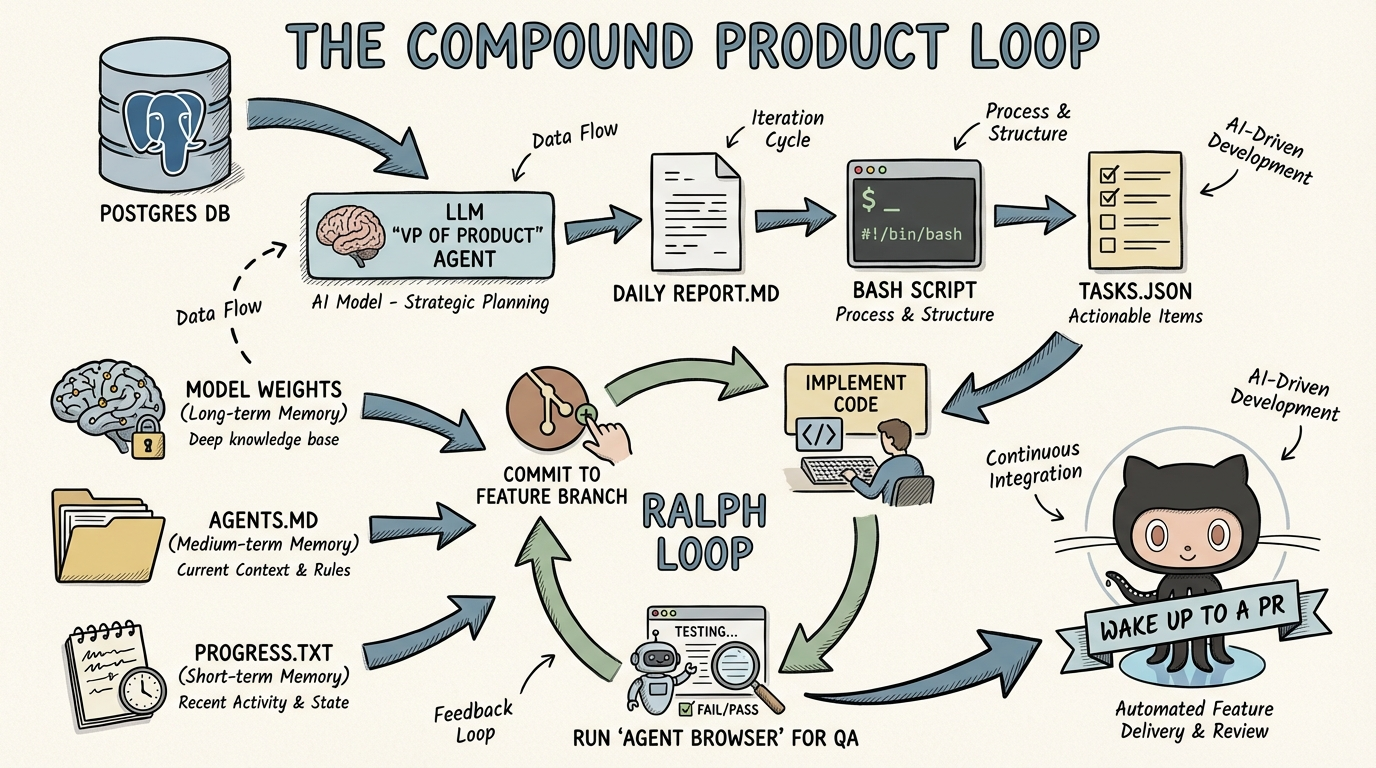
Shift from manual feature planning to an autonomous 'Compound Product' loop that analyzes database metrics, generates PRDs, and executes code changes via non-interactive Bash scripts.
Key Insights
Non-Interactive Agent Spawning via CLI
01:38:45Use CLI flags like 'amp -x' to trigger agents from Bash scripts. This allows you to run multiple background instances without manual oversight, bypassing the bottleneck of interactive chat interfaces.
Tiered Memory Architecture for Agents
01:50:53Manage agent context using three layers: Long-term (model weights), Medium-term (agents.md for repo-wide rules), and Short-term (progress.txt for current session gotchas). This prevents agents from repeating mistakes within a single feature build.
Direct Postgres-to-Prompt Pipelines
01:40:40Automate product management by having a script pull raw Postgres data directly into an LLM prompt. The agent acts as a 'VP of Product,' identifying funnel leaks and writing its own implementation tickets.
Atomic Task JSONs for State Management
01:49:51Convert PRDs into JSON files containing tasks with boolean 'completed' flags. This allows a Bash loop to track progress across multiple agent restarts and ensures clear acceptance criteria for autonomous verification.
Systems
Compound Product Loop
- Run a midnight cron job to pull acquisition/retention data from Postgres.
- Generate a Markdown report using Opus 4.5 to identify the #1 product priority.
- Use a Bash script to analyze the report and generate an analysis.json file.
- Spawn an agent to create a feature branch and write a PRD with atomic user stories.
- Execute a 'Ralph Loop' that iterates through tasks.json, implementing and committing code.
- Use 'Agent Browser' to autonomously verify browser-based acceptance criteria.
- Push the final PR for human review.