Dan
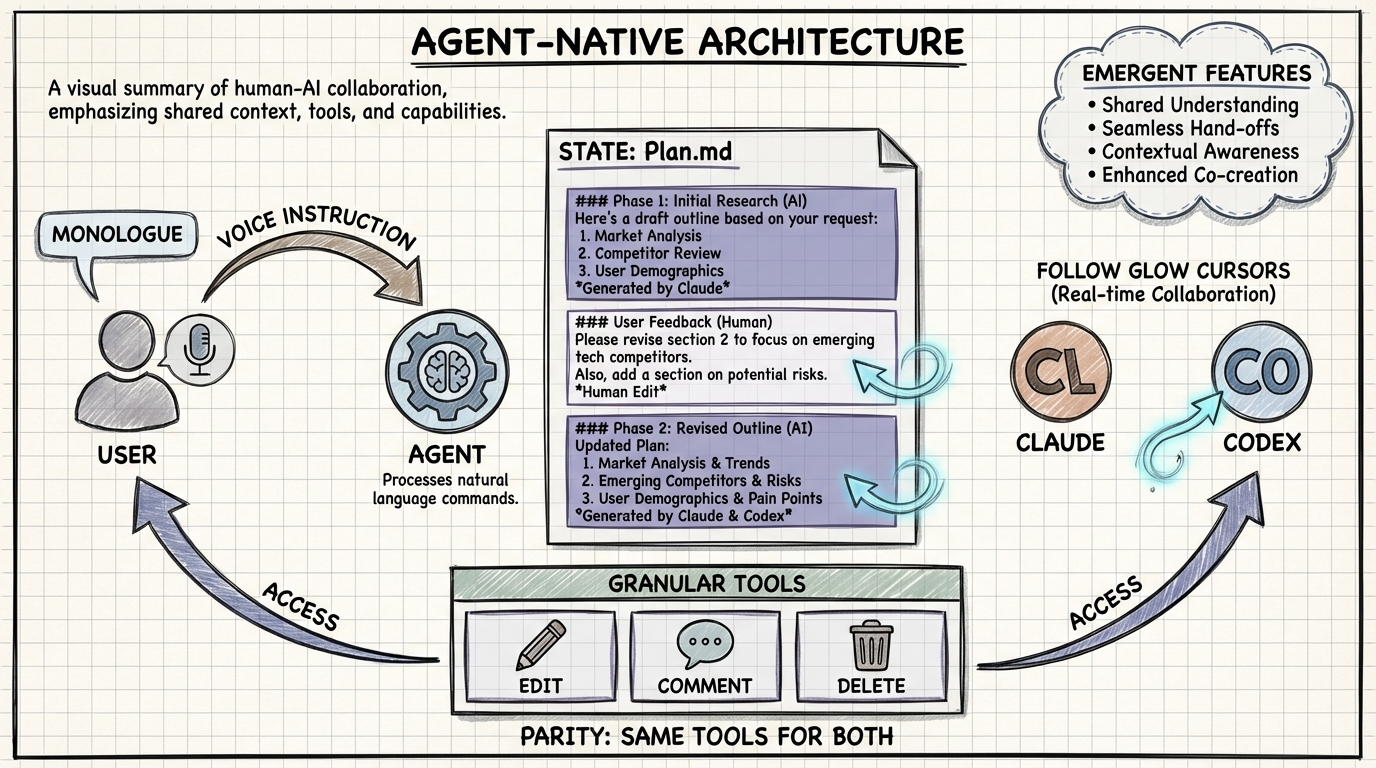
Agent-native design shifts from hard-coded features to 'parity and granularity,' where agents use the same atomic UI tools as humans to execute unprogrammed, emergent tasks.
Key Insights
The Parity Principle for Agents
00:26:43Every UI action available to a human must be exposed as a tool to the agent. This allows agents to perform complex bulk actions (like 'clear all comments') that were never explicitly coded as features.
Granularity Over Monolithic Features
00:26:55Provide agents with small, atomic tools rather than high-level functions. This enables the agent to combine tools in novel ways to solve edge cases without developer intervention.
Visual State Tracking in Collaborative Writing
00:11:30Use color-coding (e.g., purple highlighting) to distinguish AI-generated text from human edits within a document to maintain a clear sense of provenance and review status.
Agent Presence and 'Follow Glow'
00:17:54Implement visual indicators like a border glow or active cursor tracking when an agent is processing a document to prevent the 'black box' effect and allow real-time human supervision.
Systems
The Vibe-to-Code Dictation Loop
- Open a high-accuracy dictation tool (e.g., Monologue) to verbally describe bugs, UI improvements, and logic changes.
- Paste the raw transcript into a specialized planning agent/plugin.
- Direct the agent to update a centralized 'plan.md' or 'work tree' file to maintain state.
- Execute the code changes via an agent-native CLI or IDE integration.
Agent-Native Editorial Review
- Load a company style guide or specific writing rules into an agent's system prompt.
- Launch the agent as a 'reviewer' within the markdown editor.
- The agent iterates through the document, applying suggestions as 'Track Changes' rather than direct overwrites.
- Human editor performs a final pass to 'Apply' or 'Reject' suggestions.