Kevin
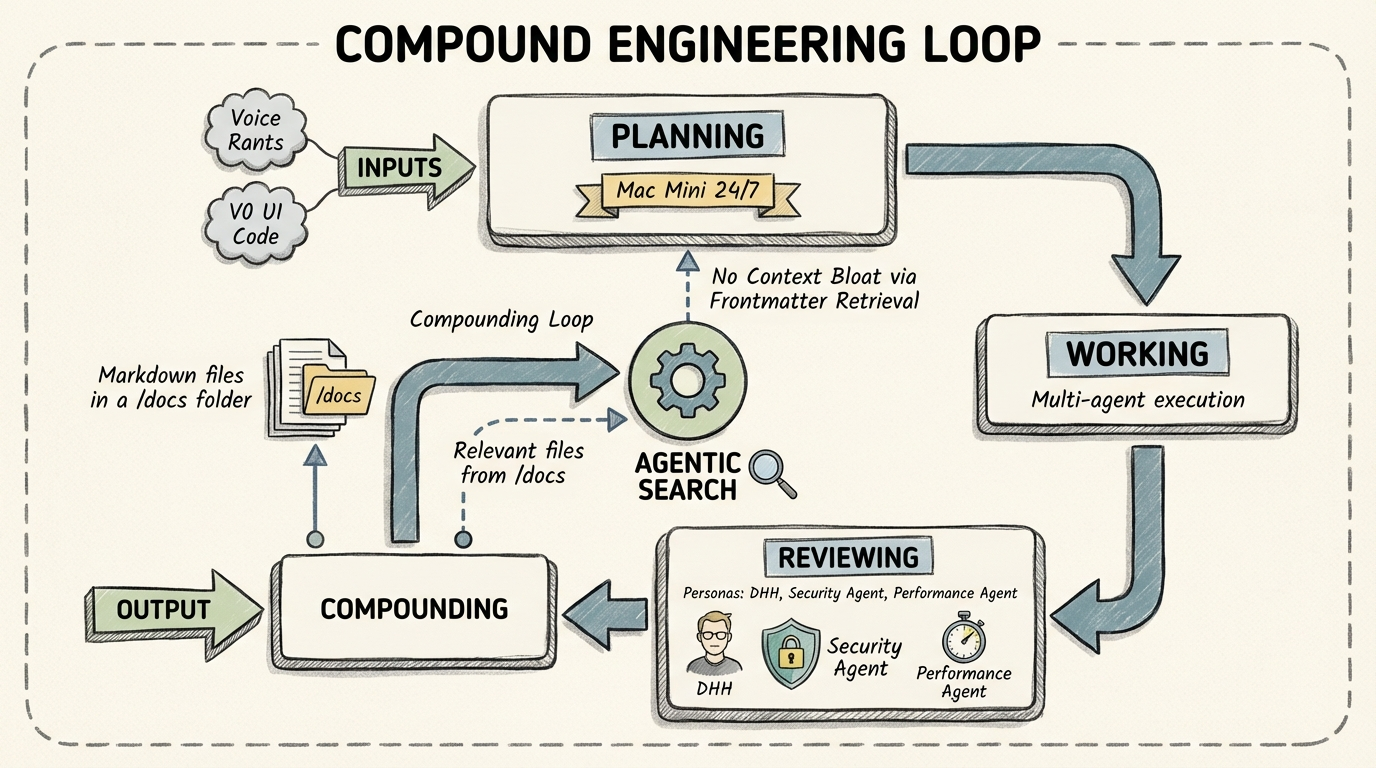
Compound engineering replaces 'vibe coding' with a structured, iterative loop of planning, multi-agent review, and persistent knowledge extraction to maintain code quality at scale.
Key Insights
Senior-Level Planning as Model Steering
05:45:32High-quality planning doesn't just provide instructions; it forces the LLM to access its 'senior engineer' training data rather than its 'average' data, significantly improving the first-compile success rate.
Context Management via Compounding
05:50:49Instead of bloating context windows with a single massive state file, extract specific patterns into a /docs folder with markdown frontmatter for agentic retrieval during the planning phase.
Opinionated Review Personas
05:58:15Use highly opinionated agent personas (e.g., DHH) to critique code; this prevents the 'averaging' effect of LLMs and forces the system to adhere to specific architectural standards.
The 24/7 Agentic Mac Mini
05:55:13Offload long-running autonomous coding tasks to a dedicated Mac Mini, leveraging AppleScript and iMessage for system-level status notifications while the agent runs end-to-end flows.
Systems
The Compound Engineering Workflow
- Invoke /plan to define architecture and database schema.
- Invoke /work to trigger multi-agent code generation.
- Invoke /review to run security, performance, and opinionated style checks.
- Invoke /compound to extract learnings into persistent markdown documentation.
- Use agentic search to inject relevant docs into the next /plan cycle.
Rapid Tool Grokking Pipeline
- Paste GitHub link into DeepWiki (Devin) to generate a technical brief.
- Upload brief to NotebookLM.
- Generate a 15-minute 'Deep Dive' podcast.
- Listen at 2x speed to understand the tool's architecture in 7 minutes.
Visual-to-Production Pipeline
- Iterate on UI/UX in V0 until the 'gut feeling' is right.
- Download V0 code into a local project folder.
- Run the Compound Engineering loop to build out production logic and backend integration.