Thariq
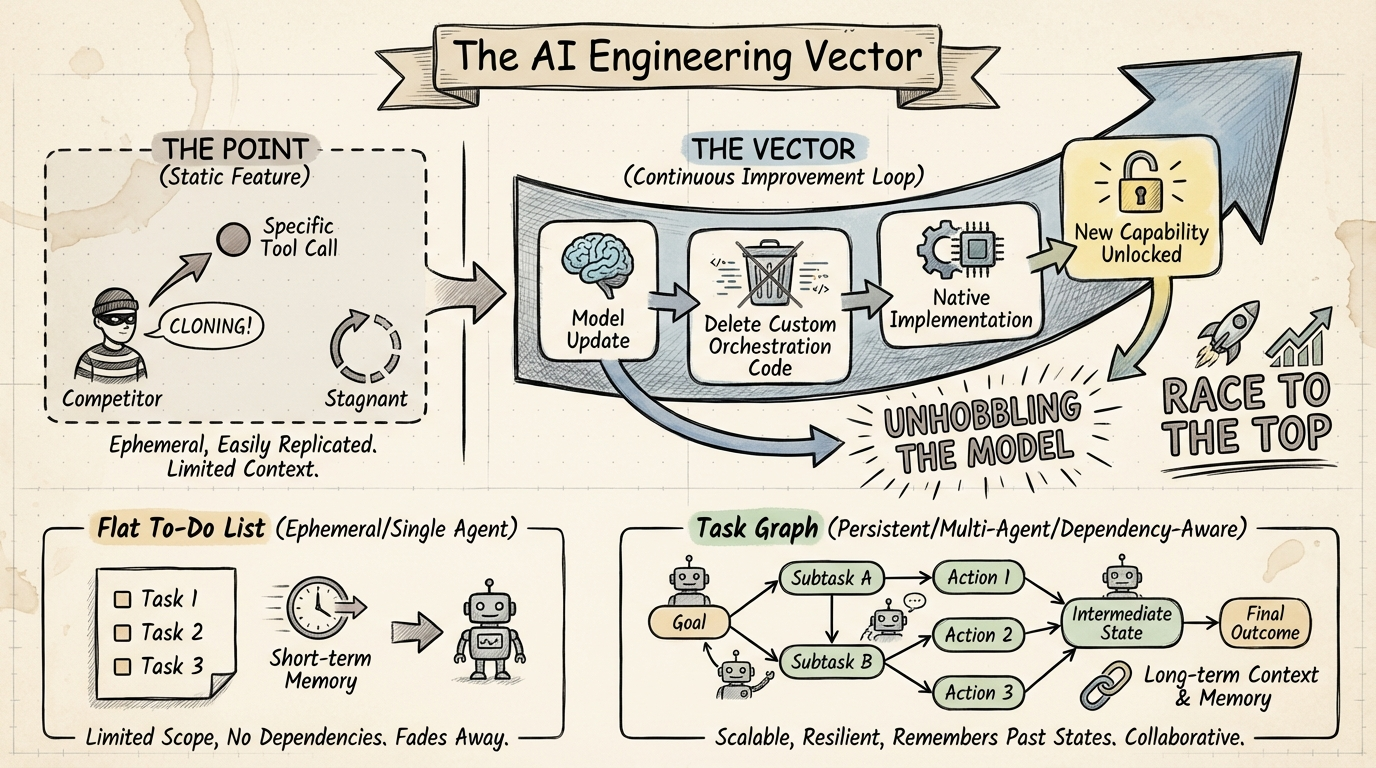
AI engineering moats are built on 'vectors, not points,' requiring a ruthless willingness to delete custom orchestration code as model capabilities advance to keep the implementation 'native.'
Key Insights
The 'Delete Code' Engineering Mandate
06:17:01Avoid over-engineering complex orchestration for current model limitations; when a new model 'unhobbles' a capability, you must delete your custom code to prevent technical debt from blocking native model performance.
Shift from Ephemeral To-Dos to Persistent Tasks
06:19:06Move away from flat, session-specific to-do lists toward 'Tasks' (V2) which support dependency graphs and persist state across multiple agents and sessions.
Elicitation as a Model 'Unhobbling' Strategy
06:04:50Instead of the model guessing intent, implement specific 'ask_user' tools that allow the model to pause and resolve ambiguity, effectively expanding its 'space in the box' for complex planning.
Moats are Vectors, Not Points
06:24:05Competitors can clone a specific feature (a point), but they cannot clone the 'vector'—the institutional knowledge of what was tried and discarded, and the direction of the next iteration.
Systems
Spec-Driven Long-Running Agent Loop
- Spend 30 minutes manually writing a high-density technical specification.
- Use 'Spec Mode' to reduce all possible ambiguity for the agent.
- Hand off the spec to a high-reasoning model (e.g., Opus) for long-duration execution.
- Allow the model to run autonomously for extended periods now that the 'ambiguity floor' is lowered.
Engineer-Led Ground Truth Feedback
- Eliminate dedicated QA and Support teams for dev tools.
- Require engineers to read GitHub tickets and social feedback directly to maintain 'vibe' and 'feel'.
- Identify 'meta-patterns' in unstructured user feedback.
- Synthesize patterns into 'composable building blocks' rather than one-off feature requests.