Ashe
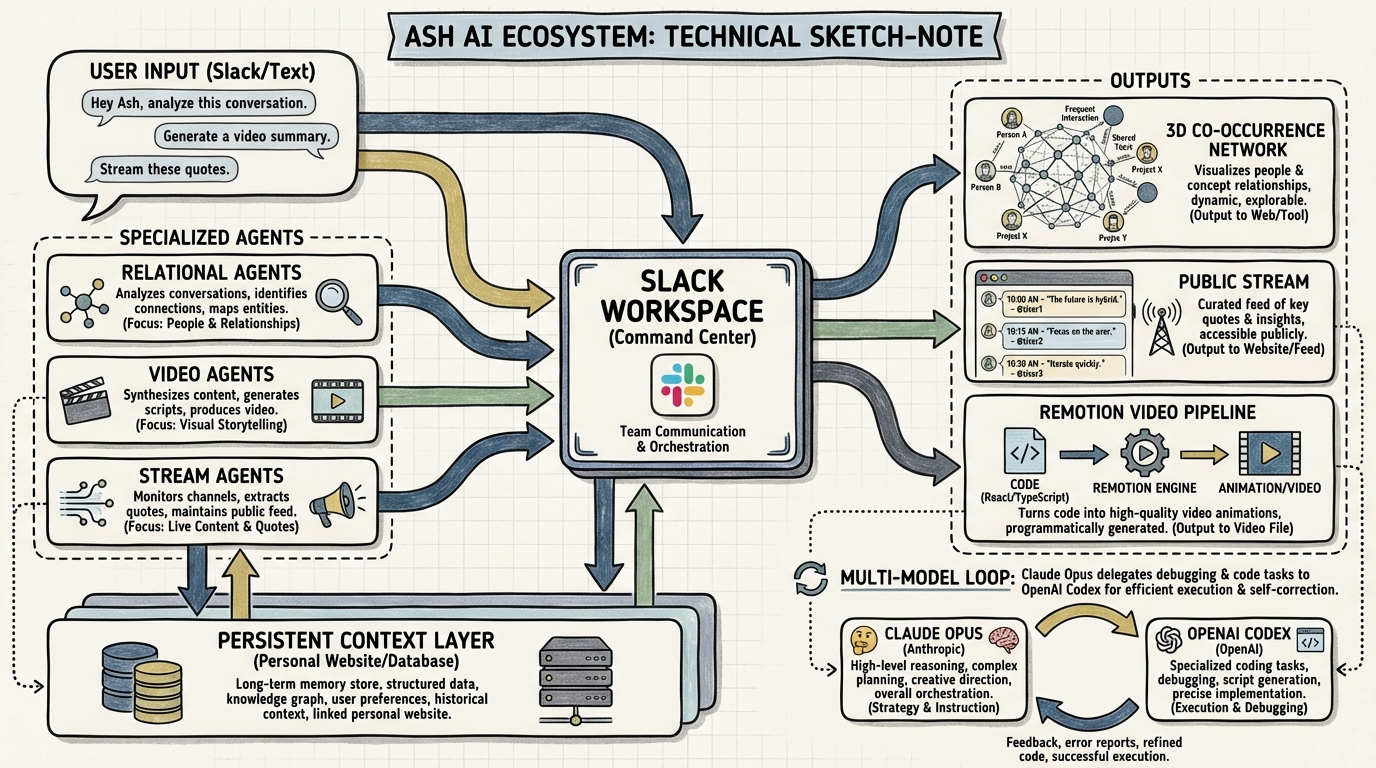
Build a persistent, multi-agent personal workspace in Slack where specialized bots maintain long-term context across all projects, public streams, and relationship networks.
Key Insights
Video as the 'Proof of Human' Layer
01:08:44As AI-generated text and images become 'slop,' video remains the primary medium for authentic connection because it preserves human imperfections like stutters and physical state (e.g., being sick).
Cross-Model Debugging Orchestration
01:23:44Use Claude Opus to orchestrate and prompt OpenAI Codex/o1 specifically for debugging loops; Opus handles the high-level reasoning while Codex/o1 provides the precision required for technical fixes.
Relational Intelligence via Co-occurrence Networks
01:06:16Move beyond contact tables to co-occurrence networks to visualize the 'optimization landscape' of relationships, identifying who you are connected to and why based on shared context.
Systems
Ambient Thought Stream
- Send a text or Slack message to a dedicated agent webhook.
- Agent processes the input using OpenAI tool calling.
- A Next.js cron job updates a public-facing 'mood board' or stream page (e.g., ash.ai/stream).
- The entry is tagged with metadata like location or specific project context.
Video-as-Code Explainer Workflow
- Define a visual style in a TSX/JS template using Remotion.
- Use Claude Code with the Remotion skill to programmatically generate video frames.
- Iterate by feeding the Remotion Studio output back into the LLM to fix layout or animation timing.
- Link the final render to a personal dashboard for public accountability.